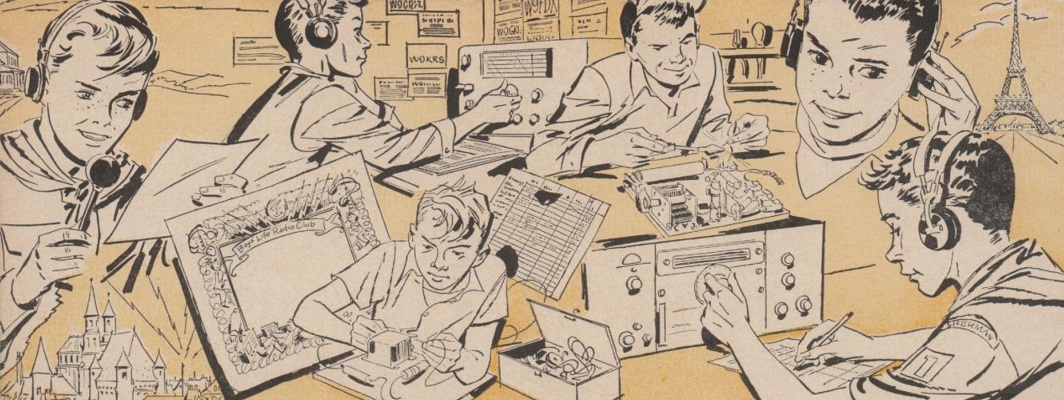
 My favorite amateur radio blog comes from Jeff Davis, KE9V. If you have been following Jeff’s blog through the years you’ll have seen a constant evolution of his site and content. In addition to his ponderings of the current state of ham radio, Jeff has produced a number of engaging podcasts. Long Delayed Echoes was Jeff’s podcast series that covered a great deal of the early history of amateur radio. It featured selections from Clinton B. DeSoto’s 200 Meters & Down as well as other significant historical sources of ham history. In addition to his written contributions to QST (see the May 2005 issue on page 56) Jeff has also shared his talent for fiction with us. He has several other ham radio related stories that he posts now and again on his blog (… it is worth checking his blog frequently because once in a blue moon he will put links up to his stories… my favorites are QRP Christmas and Tragedy on the Trail).
Besides his blog, Jeff prodigiously uses social media and you would likely enjoy his ham radio musing that can be read via Twitter and Google +.
Jeff combined his podcast talents along with his fiction writing skills with the production of Cornbread Road. All 13 episodes of the serial are currently available and on the 30th of September, Jeff has promised us a final installment. I’m looking forward to that!
 … there was Hugo Gernsback. Here are a few of his contributions:
 (3) Once I have my antenna situation under control, I can take the hamshack innards to the next level.


 Today I got the opportunity to conduct another phone interview with a radio amateur who served in World War II. The gentleman has been a licensed ham for 72 years and still has an active license. I found his name in a pre-World War II QST. He’d written a letter after he’d answered the call to duty and had been sent to Fort Monmouth, NJ to undergo training in the Signal Corps. His letter to QST laid out the process of what a ham would experience once he made the jump from the civilian world into the Army. I wanted to ask him about his experiences during training, had there been other hams in his unit? Did his amateur radio skills help him become a better Army signalman? Where was he sent after Fort Monmouth? Europe… the Pacific? The gentleman had served his country along with our greatest generation and I wanted to honor his service by hearing his war stories. Unfortunately the years had eroded his memories and he couldn’t recall much more than that he had been in the Army for five years and had briefly served at Fort Monmouth. He immediately recalled his holding of an amateur radio ticket for 72 years and it was heartening to think that amateur radio had played a major part in his long life. I sincerely thanked him for his service to our nation but was somewhat saddened by the fact that his wartime experiences are lost in the shadows of history.
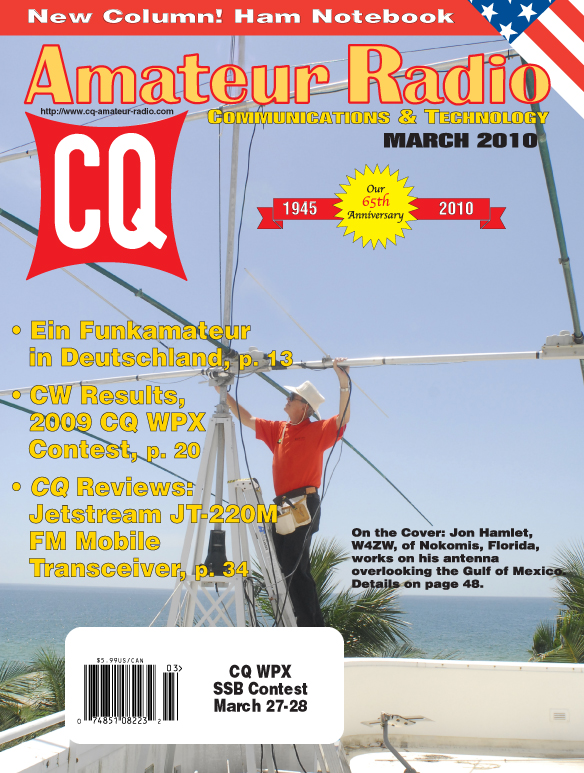 I got my March issue of CQ Magazine and enjoyed the renaming of the Beginner’s Corner column to The Ham Notebook. Columnist Wayne Yoshida, KH6WZ, explains the name change to reflect a column that contains information that every ham should know. Continuing on the notebook theme, Wayne notes the importance of record keeping for on air activity, a way to track contacts for the various awards,


 The Signal Corps Bulletin was the professional journal of the US Army’s Signal Corps from 1920 to 1940. After the establishment of the War Department’s radio net, a section was included in the back were individual stations could make comments about their equipment, personnel transfers, and sometimes snipe at rival stations. Station WAR, located at Ft. Meyer, VA (near Washington D.C.) was net control for the net that reached all the way out to San Francisco, Seattle, Alaska, Hawaii and even the Philippine Islands. The following is taken from a Bulletin from the late 20s which I found pretty amusing:
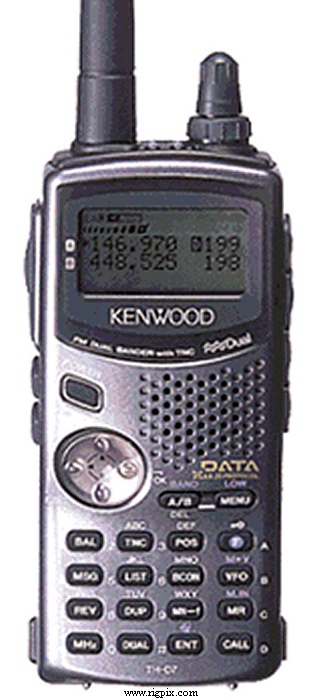 I eventually figured out how to set the tone and was on the repeater with the other folks. Then with a bit more thought and troubleshooting, I discovered my feedline connection to the rig had come loose and with that fixed I was back in business. Part of the problem is that I have a relatively new rig in the truck, the Kenwood TM-D710A. It is a very complicated rig and I have only scratched the surface on how to operate it. I was able to interface it with the Garmin Nuvi 350 thanks to a cable from
